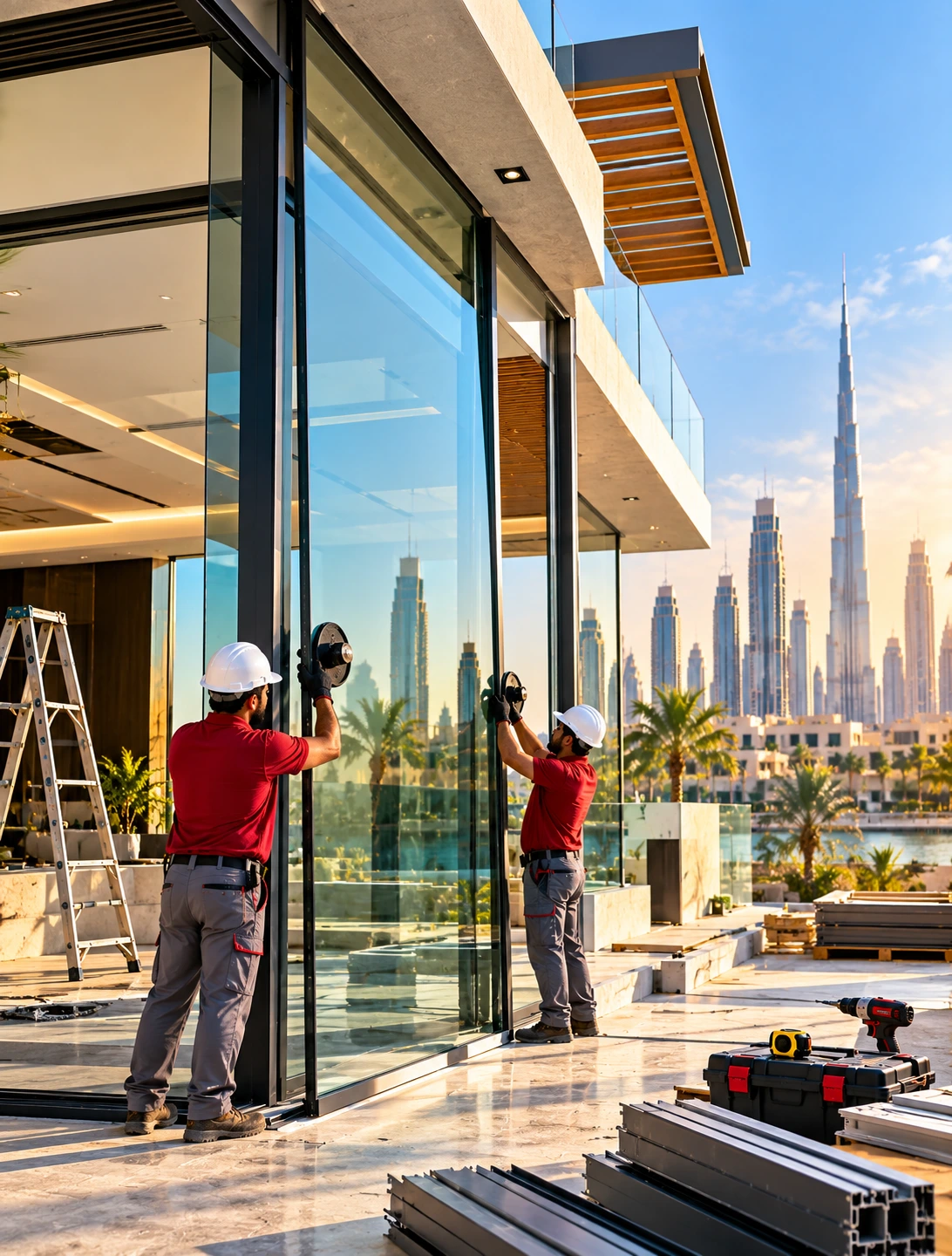
Look at the typical example of a modern villa, office tower, a showroom, a hotel, or a commercial building in Dubai, and you will see a good chance that it will contain lots of two materials: aluminium and glass. That is not a surprise. The use of modern aluminium and glass in Dubai works particularly well because architects can create contemporary styling with natural daylight, large openings, durable framing with a carefully designed performance for the building-envelope. Dubai’s climate plays an essential role in the choice of materials for construction.
A large window may look great in an architect’s rendering, but that does not prevent the sun’s heat from getting through the window into the building. That is why Dubai’s building regulations take into account the factors such as thermal transmittance, shading performance, light transmission, and other characteristics related to external glazing. The Dubai Municipality also regulates glazed glass used in buildings through its product-certification framework.
So why have aluminium and glass become such common partners in Dubai architecture? The answer involves much more than appearance.
1. Aluminium and Glass in Dubai Create a Modern Architectural Look
Modern architecture often favours simple lines, large openings, visual continuity, and minimal unnecessary decoration. Aluminium frames suit that language well. Manufacturers can form aluminium into detailed profiles for windows, sliding doors, curtain walls, partitions, and façade systems. The extrusion process allows designers to create many different profile shapes while incorporating functions such as tracks, seals, drainage paths, and hardware connections. Glass complements those frames by creating transparency.
Together, the two materials can produce:
- Large windows
- Slim-frame sliding doors
- Glass entrances
- Curtain-wall façades
- Office partitions
- Balcony enclosures
- Shopfronts
- Skylights
- Internal glass walls
This versatility explains why you see the combination across everything from compact apartments to luxury villas and commercial towers. It gives architects freedom without requiring every building to look the same. That is useful in a city where subtle architectural understatement and 70-storey statements somehow manage to coexist peacefully.
2. Aluminium and Glass in Dubai Brings More Natural Light Into Buildings
One of the clearest advantages of architectural glass is daylight. Large windows can reduce the visual separation between indoor and outdoor spaces and help interiors feel more open. This matters particularly in villas, offices, restaurants, hotels, and retail spaces where designers often want strong visual connections with gardens, terraces, city views, or surrounding architecture.
However, good glazing design involves balance. More glass does not automatically mean a better building. Dubai Municipality’s Al Sa’fat requirements specifically consider light transmittance together with thermal transmittance and shading performance for glazed building elements. That is important because glass needs to manage several jobs at once.
Designers may want daylight and clear views while also limiting unwanted solar heat. In other words, “make the entire wall glass” is not quite a complete engineering specification.
3. Modern Aluminium and Glass in Dubai Can Help Control Solar Heat
Dubai receives intense sunshine for much of the year, so exterior glazing needs appropriate thermal performance. Modern solar-control glass can allow useful daylight through while reducing part of the unwanted solar energy entering a building. Glass for Europe explains that solar-control glazing selectively reduces unwanted solar radiation while maintaining daylight and visual comfort. Dubai’s own requirements reflect the importance of this issue.
Under Al Sa’fat, performance criteria for glazed elements vary depending on the proportion of glazing in the external wall. The criteria address summer U-values, shading coefficients, and minimum light transmission. This is one reason the phrase “glass is glass” should make a property owner slightly nervous. Different glazing configurations can perform very differently.
Exterior applications may use combinations involving:
- Insulated glass units
- Solar-control coatings
- Low-emissivity coatings
- Toughened glass
- Laminated glass
- Different air or gas spaces
- Different glass thicknesses
Dubai Municipality maintains certification requirements for glazed glass under Al Sa’fat and publishes certified glazing configurations. For a significant exterior glazing project, the actual specification matters far more than whether the glass looks pleasantly blue in the showroom.
4. Aluminium and Glass in UAE Offers Strong Durability for Building Applications
Aluminium has useful characteristics for exterior architectural work. When exposed to air, aluminium naturally develops a thin oxide layer that helps protect the underlying metal against atmospheric corrosion. Architectural aluminium can also receive anodised or coated finishes for additional protection and appearance. It also does not rot when exposed to moisture in the way some organic materials can.
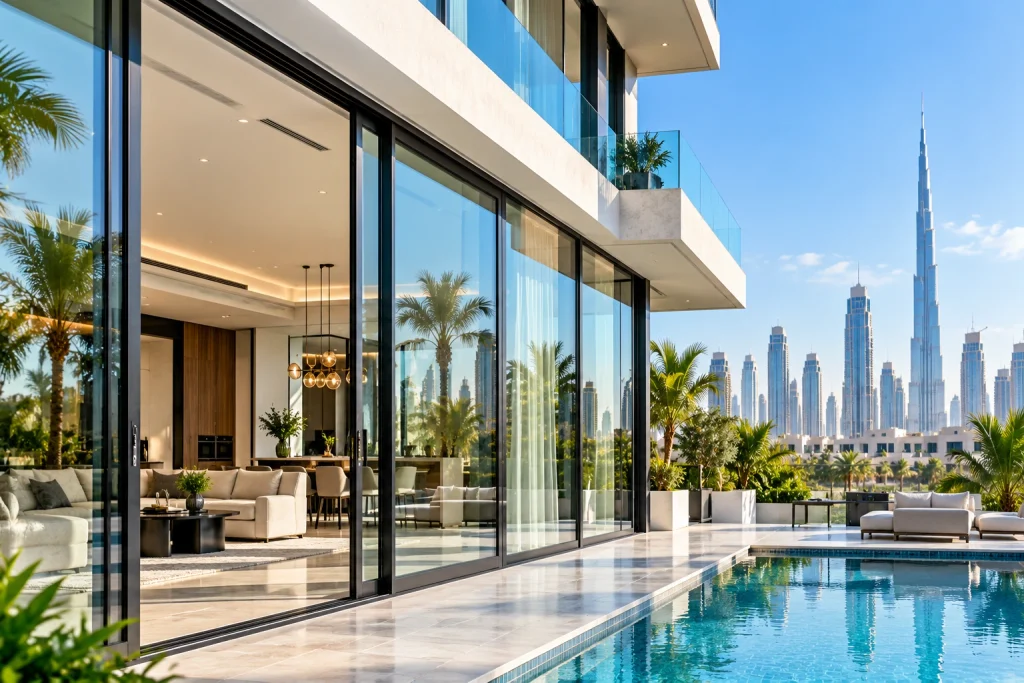
That makes properly specified aluminium useful for:
- Windows
- Exterior doors
- Sliding systems
- Curtain walls
- Pergolas
- Façade elements
- Louvres
- Shopfronts
Of course, durability still depends on design, alloy, finish, fabrication, installation, exposure, and maintenance. Aluminium is a good material. It has not, unfortunately, developed supernatural powers. Poor drainage, inappropriate fasteners, weak fabrication, damaged coatings, or bad installation can still cause problems.
5. Aluminium and Glass in Dubai Allows Slimmer-Looking Frames
One reason architects like aluminium is its ability to create relatively slender structural profiles for many window and door applications. That can increase the visible glass area and produce a cleaner appearance. Minimal sliding-door systems have become particularly popular in contemporary villas because they can create wide openings between living areas and terraces.
The design can make an indoor space feel connected to:
- Gardens
- Pools
- Courtyards
- Balconies
- Outdoor seating areas
But frame width should never become the only selection criterion. A slim frame still needs to perform properly. The system must account for glass weight, dimensions, wind loads where applicable, rollers, locking, seals, drainage, thermal performance, and expected usage.
The thinnest frame is not automatically the best frame. If architecture worked that way, engineers could replace most specification meetings with a ruler.
6. The Combination Works for Both Residential and Commercial Buildings in UAE
Another reason aluminium and glass work in Dubai remains popular is adaptability.
Villas in UAE
Modern villas often use aluminium and glass for large sliding doors, entrance systems, bedroom windows, balcony doors, skylights, and pool-facing living spaces.
Apartments in UAE
Apartment buildings may use aluminium-framed windows, balcony doors, façade glazing, and common-area systems.
Offices in UAE
Glass partitions can divide work areas without completely blocking visual connection or natural light.
Retail Properties in UAE
Shopfront glazing provides visibility into stores, while aluminium framing creates structured entrances and display areas.
Hotels and Hospitality in UAE
Hotels commonly use glass in façades, entrances, internal partitions, shower enclosures, balustrades, and feature elements. The same two basic materials can therefore support very different architectural needs. That flexibility gives designers more freedom than a single fixed system would.
7. Aluminium and Glass in Dubai Can Support Different Colours and Finishes
Aluminium does not need to remain metallic silver. Architectural frames can receive different surface finishes and colours depending on the selected system and manufacturing process.
Common architectural appearances include:
- Black
- Dark bronze
- Grey
- White
- Metallic finishes
- Wood-effect finishes
This makes aluminium easier to coordinate with stone, timber, concrete, plaster, tiles, and other façade materials. Dark aluminium frames have become particularly common in contemporary properties because they create a strong visual outline around large glass areas.
However, colour selection should consider more than trends. Architects also need to think about façade design, exposure, finish quality, maintenance, and compatibility with surrounding materials. A colour may look wonderful on a sample measuring ten centimetres. Covering an entire villa in it is a slightly larger commitment.
8. Aluminium and Glass in Dubai Is Highly Recyclable
Aluminium also has an essential material-life-cycle advantage. The International Aluminium Institute explains that aluminium is capable of being recycled without fundamentally degrading the metal’s properties, and its research into aluminium in buildings also underlines the importance of recycling and material recovery at the end of the building component’s service life. That does not necessarily make every aluminium building product “sustainable”, though.
Environmental performance depends on such factors as sourcing, manufacturing, transport, design life, the recycled content, operational performance, and eventual recovery. Recyclability makes aluminium fit in well with circular material strategies. Dubai’s Al Sa’fat framework also aims to promote more sustainable building performance and improve efficiency while diminishing environmental impact.
9. Aluminium and Glass Can Be Relatively Easy to Maintain
Well-designed aluminium and glass systems typically require relatively simple routine care. Glass requires cleaning. Tracks should remain free from dirt. Drainage paths should stay clear. Hardware may need occasional adjustment or replacement. Seals need inspecting as they age. Aluminium finishes also need appropriate cleaning according to the manufacturer’s recommendations.
Compared with materials that need frequent repainting or other treatment, properly finished aluminium can be used in many cases as a relatively low-maintenance building solution. But “low maintenance” does not mean “no maintenance”. Dubai’s 2026 building-quality legislation specifically includes the condition of windows and doors on external façades and common areas within technical building assessments.
That makes sense. Windows and doors are working building components, not decorative paintings hanging on a wall. They open, close, seal, drain, lock, and interact with the building envelope. They need to be inspected.
10. Glass Can Improve Visual Connection Without Removing Separation
Glass has another useful architectural quality: it creates physical separation without necessarily creating visual isolation.
That makes it particularly useful for modern offices and residential interiors.
A glass partition can separate:
- Meeting rooms
- Home offices
- Kitchens
- Stair areas
- Shower spaces
- Entrance lobbies
while still allowing light and visibility through. Designers can also use different types of glass depending on privacy requirements. Clear, tinted, patterned, laminated, or partially obscured solutions can produce very different results. Again, the right choice depends on the actual application.
A fully transparent conference room may look beautifully modern until someone remembers that meetings occasionally benefit from privacy.
11. Aluminium and Glass Work Well With Dubai’s Indoor-Outdoor Lifestyle
Modern Dubai villas often feature terraces, pools, gardens, courtyards, and outdoor entertaining spaces. Large sliding or folding glazed openings can strengthen the connection between those exterior areas and the interior. When open, they can create wide transitions. When closed, glass can retain visual connection while maintaining a conditioned indoor environment—provided that the glazing and framing system has suitable thermal and air-sealing performance.
That final point matters. Large glass areas must form part of the overall envelope strategy. Dubai Municipality’s Building Code explicitly includes glazed schedules and U-value calculations among its building-performance tools. A good view and good building performance do not need to be enemies. They simply need competent design.
12. Modern Aluminium Systems Can Integrate More Than Glass
Aluminium framing systems can accommodate more than one basic fixed pane.
Depending on the product and application, systems may include:
- Sliding panels
- Hinged doors
- Fixed glazing
- Louvres
- Insect screens
- Integrated locks
- Multi-point locking systems
- Automated openings
- Large glass panels
This makes aluminium useful when an architect wants several related functions to share one visual language. A property can maintain similar frame finishes across windows, entrance doors, and sliding systems even though each performs a different job. That consistency contributes to a cleaner architectural result.
The Specification Matters More Than the Material Name
This is perhaps the most important point in the entire discussion. Aluminium and glass are not automatically good simply because they are aluminium and glass. Performance depends on the complete system.
When selecting aluminium and glass in Dubai, consider:
- Aluminium profile system
- Appropriate finish
- Glass construction
- Thermal performance
- Solar-control performance
- Hardware
- Frame drainage
- Weather sealing
- Glass safety requirements
- Installation quality
- Applicable certification
- Building approvals
- Manufacturer requirements
Dubai Municipality’s certification system evaluates glazed elements for thermal transmittance, shading coefficient, and light transmission under Al Sa’fat. That should tell property owners something important. A meaningful glass specification contains numbers and technical information. “European quality premium glass” is a marketing sentence. It is not a specification.
Choosing the Right Aluminium and Glass Contractor in Dubai
Materials are only part of the final result. Fabrication and installation matter just as much.
Before appointing an aluminium and glass company, ask:
- Which aluminium system will you use?
- What exact glass construction will you supply?
- Can you provide technical data?
- Does the glazing meet applicable Dubai requirements?
- Which hardware will you install?
- How will you seal and drain the frames?
- Who takes final measurements?
- What warranty applies?
- Have you completed similar projects?
For exterior systems, the contractor should also understand how frames interact with waterproofing, walls, floors, façade finishes, and other building components. Excellent glass installed badly remains badly installed glass. There is no premium coating capable of fixing poor workmanship.
Final Thoughts
There are good reasons why aluminium and glass are popular choices for modern buildings in Dubai. Aluminium offers durability, design flexibility, slim architectural profiles, multiple finishes, and strong recyclability. Glass provides daylight, views, transparency, and the ability to create large modern façades and openings.
When properly specified, modern glazing can also combine daylight with solar-control and thermal-performance requirements—an important consideration in Dubai’s climate. Dubai’s Building Code and Al Sa’fat system reflect that by placing measurable requirements on glazed building elements.
The two materials therefore work well together both visually and technically. But successful results depend on more than choosing aluminium frames and large glass panels from a catalogue.
Designers and property owners need to consider the complete system: glass type, frame design, thermal performance, hardware, drainage, sealing, certification, installation, and future maintenance. Get those details right and aluminium and glass can produce buildings that feel bright, modern, open, and refined.
Ignore them and you may still get a beautiful photograph. You will simply spend considerably more time discussing why the door whistles every time the wind blows.