Stop here if it starts by opening a bucket. The best building waterproofing tips are to understand the process. Find the source of the leak. Choose a waterproofing solution to suit that area. Prepare the substrate, repair cracks, resolve drainage issues, seal joints and penetrations, apply the system to spec, and finally test.
As you’ll see below, you may have different solutions for your roof, bathroom floor, terrace, planter and underground area. In short, diagnose where the problem is occurring and choose a waterproofing solution to suit. Repair the substrate, repair cracks, sort out drainage issues, seal joints/penetrations, apply the correct number of coats (manufacturer’s spec), and protect the membrane from other trades.
1. Diagnose the source of the leak
Finding a damp spot will tell you WHERE the issue can be seen but not necessarily WHERE it is coming from. Look up, behind, and around the area. Check roof outlets, balconies, external joints, plumbing connections, pipe penetrations, shower outlets, sealants, and any visible cracks. Look for any signs of ponding, loose finishes, blistering paint, and white salt deposits.
But is it even a waterproofing issue? If there is a leaking pipe in the wall behind the bathroom, you need to repair the plumbing issue. Painting over with a waterproof coating will just increase the cost of your invoice! This is one of the easiest ways to improve on generic advice.
2. Choose the right waterproofing solution in UAE By Using Building Waterproofing tips
There isn’t a ‘best’ waterproofing product for the whole building. For good reason, the SWR Institute differentiates between waterproofing and damp proofing. Waterproofing solutions are for water penetration and situations where there is water pressure. Whereas damp proofing is a lower level of protection against moisture. The right waterproofing solution will depend on how exposed it is. For example, a roof will have different requirements from an underground wall.
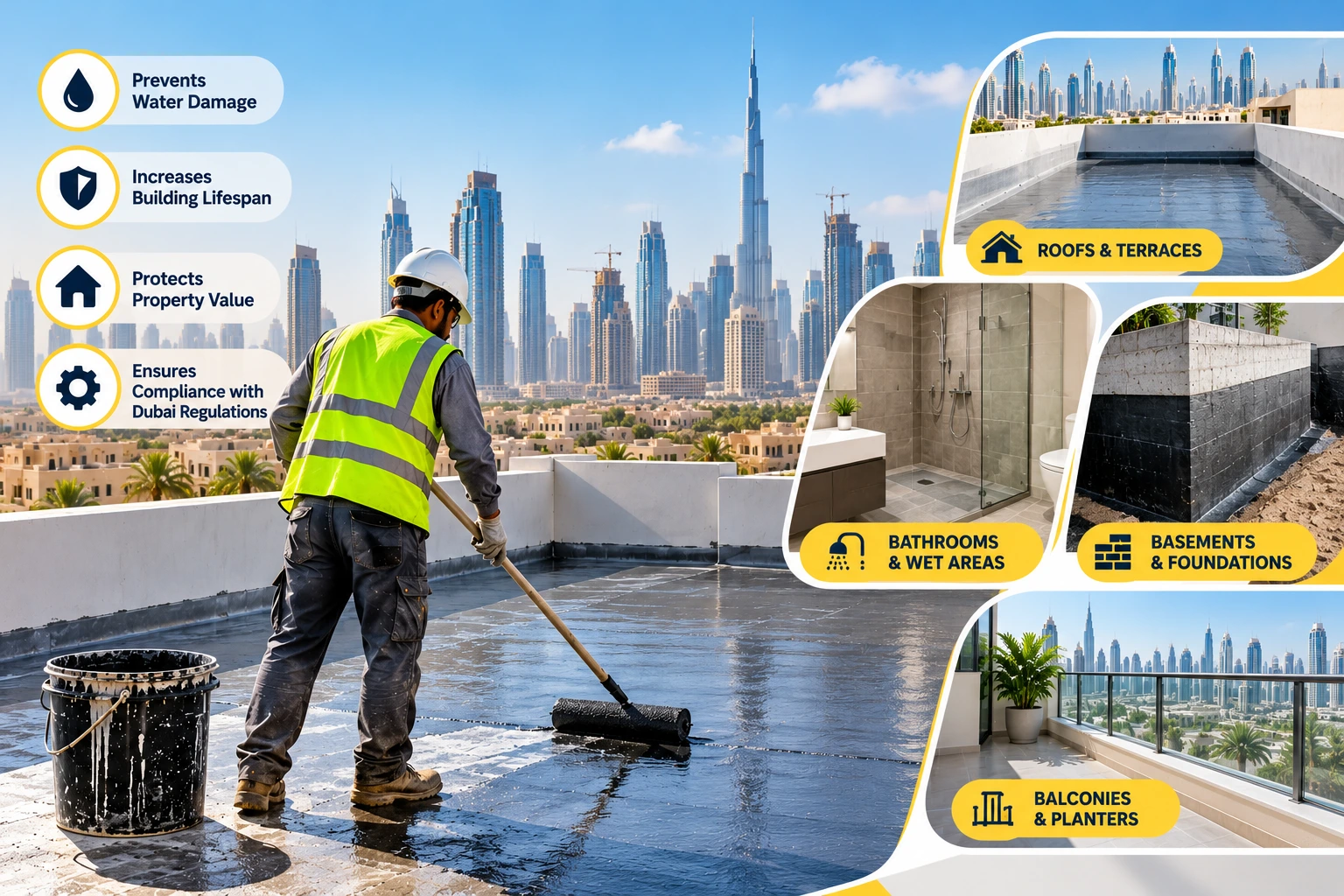
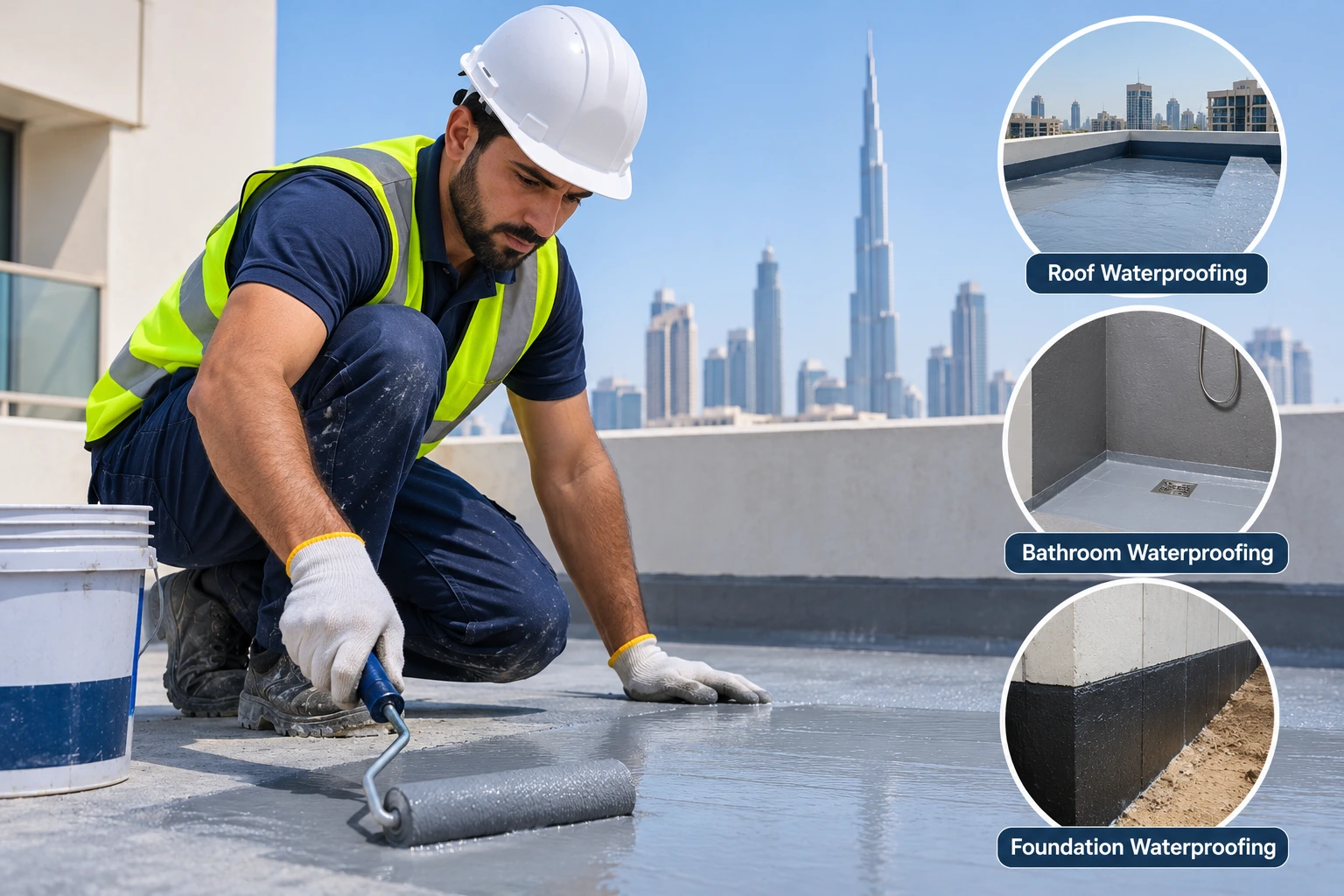
Roofs/Terraces
Focus on the whole system. Check:
- drainage and falls;
- outlets and overflows;
- parapets and upstands;
- penetrations;
- membrane continuity;
- protection from later work.
.
The BSBG notes that tiles, screed and ballast will not provide full waterproofing. If drainage is not good, then water can get trapped. Ensure that the waterproofing and drainage work well together.
Bathrooms/Wet Areas
Bathrooms will have high risks around corners, showers, floor drains and pipe penetrations. A beautiful tile finish won’t tell you much about the waterproofing underneath. It is therefore so important to test!
Foundations/Underground
Underground waterproofing will require a different design due to moisture in the soil, drainage, and potential water pressure. Depending on the access and design, there are different types of waterproofing solutions. Positive side waterproofing is applied to the face of the structure that will be hit first by water. Negative side waterproofing is applied internally if there is no access externally. Don’t just choose based on what is in the product brochure!
3. Get the substrate right before applying anything in UAE
Waterproofing products bond to the surface. If there is a lot of dust, oil, poor concrete, incorrect coatings, or unresolved issues, then the membrane will start at a disadvantage. Common reasons for membrane failures include poor surface preparation, high moisture levels in the substrate, thin liquid-applied coatings, no primer, and poor curing (Optimech).
Typically, the surface will be cleaned and repaired as per the chosen waterproofing solution. Cracks: Don’t just paint over cracks! Check what type of crack you have. Superficial cracks, active cracks, construction joints, or intentional movement joints. The repairs will need to be appropriate.
4. Sort out drainage
This is often overlooked. Waterproofing is to stop water getting into the structure. Whereas drainage is to move the water away from the waterproofing. Ideally, you want both! UltraTech states that terrace slopes should be planned so that water runs to drainage (not pooling).
The BSBG also mentions that the waterproofing line should connect to the building’s drainage.
Check the following on your existing property in Dubai: Roof outlets, Terrace drains, Balcony drains, Shower wastes, Gutters, downpipes, and any areas where water is pooling. A larger waterproofing bucket will not help if the drainage is blocked!
5. Fix drainage before asking the membrane to fight standing water in UAE
The centre of a flat slab will usually be fine. Issues will occur around joints. Take care with pipes, drains, corners, parapets, thresholds, wall-to-floor joins, equipment supports and movement joints. Sheet membranes need to be lapped, sealed, and terminated correctly. Liquid membranes need to be applied with the correct amount of material and reinforcement/detailing as per the system spec.
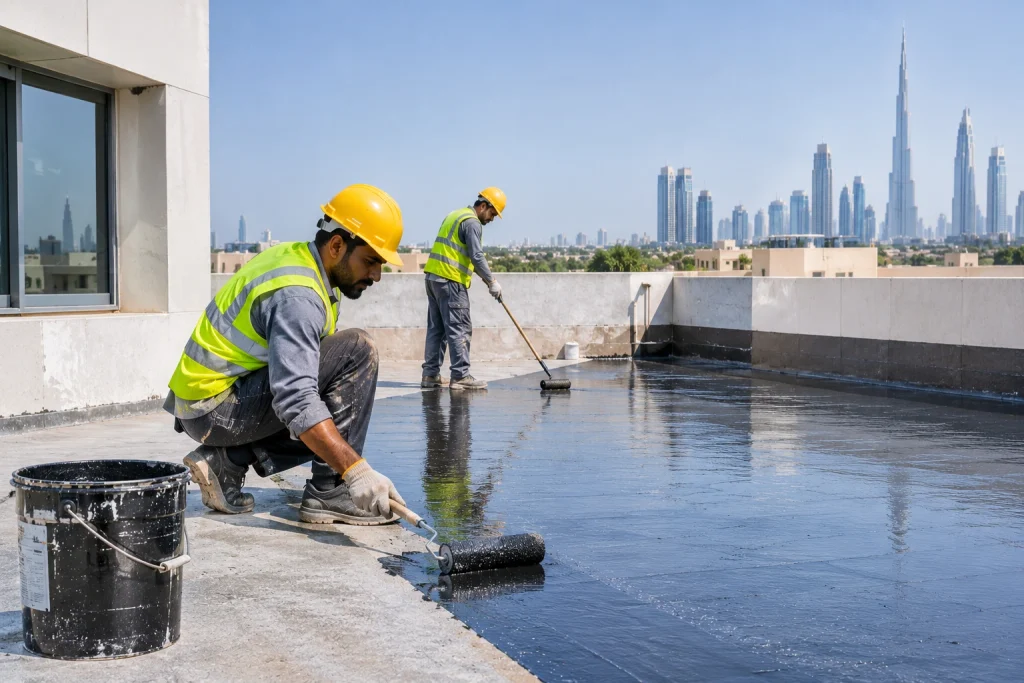
It is important that the waterproofing line is continuous where membranes meet other parts of the building (BSBG). SWR Institute also mentions seams, terminations, and penetrations. One poorly detailed drain can ruin a huge amount of good work! Water is annoyingly equal!
6. Follow the product system, not a universal recipe in UAE
Many waterproofing guides online are not reliable. They state that all concrete should be a certain age, all membranes need two coats, all primers are the same, and all systems need a certain amount of curing. Products will vary. For example Ceresit have their own guidelines for foundations.
Their CR 166 system has very specific requirements for substrate preparation, pre-wetting, and timings. This is specific to this product and shouldn’t be applied to other membranes such as polyurethane, acrylic, bitumen, etc.
Check the following for the product you are using:
- substrate-moisture limits;
- approved substrates
- application temperature;
- consumption rate;
- finished thickness;
- number of layers;
- reinforcement requirements;
- recoat window;
- curing period.
Liquid membranes – Measure thickness as per spec. Don’t assume it looks thick!
7. Protect finished waterproofing from everyone else in UAE
Even if everything is done correctly by the waterproofing contractor, they can still lose the battle. A membrane can be damaged by a ladder leg, sharp tile, drill, falling item, or careless screeding. Ensure that the waterproofing is protected once completed.
This is especially important for roofs, terraces, wet areas and underground areas that will have finishes, insulation, boards or backfill. The PCA also advises owners to protect the waterproofing once installed. This should really be noted!
8. Test before tiles, screed or other finishes hide the work in UAE
If your approved spec states that a watertightness test is required, then ensure that this is carried out whilst the membrane is still accessible. Depending on the system and build, there will be different tests. For wet areas, a controlled flooding test may be required. Other systems will have seams checked, adhesion tested, electronic testing, or whatever is specified. Don’t just assume that it needs 24hrs/48hrs curing as stated on the internet.
Use the approved method and follow the manufacturer’s guidelines. The idea is that if you find an issue now, you can repair the waterproofing. If you find an issue later, you may have to remove tiles/screed/ceilings/fitted furniture. I’d rather have the first invoice!
What changes for Building Waterproofing tips in Dubai?
There will be one extra question to ask when choosing products.
Is it acceptable for the project?
Are the correct approvals in place?
Dubai Municipality has the Dubai Building Code. This is a unified set of minimum requirements for building design. Integral waterproofing systems in concrete building elements need to have a conformity certificate from the Dubai Central Laboratory and approval from the Building Permits Department (Dubai Municipality Circular 8-2-1).
Dubai Municipality also has information on certified products, including waterproofing coatings and related building materials. As a property owner, you don’t need to remember the certification codes. Ask your contractor what the product is called, what the technical data sheet is, and what approvals/certifications are applicable.
Common Waterproofing Mistakes to Avoid by Applying Building Waterproofing tips
Expensive mistakes can be very simple! Poor diagnosis, poor substrates, unresolved cracks, poor drainage, thin coatings, poor joint detailing, wrong primers, incorrect products, rushed curing, and accidental damage. Assuming that waterproof paints can be used anywhere. No, they can’t!
They can’t change the slope of your terrace, fix broken drainage connections, or replace failed movement joints. Also be wary of low-cost quotes with just ‘waterproofing’. A useful quote will tell you what system you are having, where it is going, how the surface will be prepared, how details will be dealt with, and how it will be checked.
Final Thoughts
If it is a small sealant issue and you can clearly see the cause, a full waterproofing investigation may be overkill. However, if it is recurring, roof/terrace, multiple rooms showing moisture, suspected failed waterproofing in wet areas, underground, or requires opening up existing finishes, then contact a qualified contractor.
Perfect General Contracting offers waterproofing as part of their civil work and external property services in Dubai and across the UAE. They also offer concrete repairs, plumbing, flooring, and other related trades. This is important as the leak may be more than just the membrane! Ask the contractor to show you why the leak is happening and explain why the solution will solve the issue. If they just say the brand name on the bucket, then keep asking questions!
FAQs
1. What is the best waterproofing method for a building in Dubai?
There is no single best method for every building area. Roofs, bathrooms, terraces, basements and foundations face different types of water exposure. The correct system depends on the substrate, drainage, movement, UV exposure, location and project requirements.
2. How do I know if a leak is caused by failed waterproofing?
Start by checking plumbing, drains, joints, cracks, roof outlets and nearby wet areas. A visible damp patch does not always show where water entered. If the source is unclear or keeps returning after repair, a professional inspection is the safer next step.
3. Can Building Waterproofing tips be applied over old tiles or existing coatings?
Sometimes, but only if the selected waterproofing system allows it and the existing surface is sound, compatible and properly prepared. Loose tiles, contaminated surfaces, weak coatings and hidden moisture should be addressed before applying a new membrane.
4. How long does building waterproofing last?
There is no reliable universal lifespan. Durability depends on the waterproofing system, substrate preparation, installation quality, exposure, protection, drainage and maintenance. Product warranties and technical data should be checked for the specific system being used.
5. Should waterproofing be tested before tiling or screeding?
Yes, where the approved system or project specification requires testing. Wet areas and other waterproofed surfaces should be inspected and tested before finishes hide the membrane. The exact test method and duration should follow the product and project requirements.
6. Is waterproof paint enough to stop a roof leak?
Not always. Roof leaks can come from damaged membranes, failed joints, cracks, poor drainage, penetrations or defective flashing. Waterproof paint may help in specific applications, but it should not replace proper diagnosis and repair.
7. Do bathrooms in Dubai need Building Waterproofing tips?
Bathrooms and shower areas need suitable water protection because floors, corners, drains and pipe penetrations face repeated moisture exposure. The exact waterproofing system depends on the construction details and approved project requirements.