To ensure your building waterproofing in Dubai properly, you must never try to just apply a waterproofing product. Identify the areas that may be affected by water, select the correct waterproofing, properly prepare the substrate, detail joints, penetrations, follow manufacturers guidelines, test and protect.
Waterproofing is one of those construction jobs that receives very little attention when it works properly. Nobody walks into a dry bathroom and says, “Excellent membrane detailing.” They certainly notice when it fails. Water can cause deterioration to many areas of your building including paint, ceilings, tiles, joinery and insulation, concrete and adjacent rooms. In some situations water ingress can indicate issues with your roofing system, basement, balcony, joints, drainage and building envelope.
The Dubai Municipality has guidelines regarding waterproofing materials. They allow integral waterproofing systems to be applied to concrete elements if the material has conformity certification from Dubai Central Laboratory and the waterproofing is approved with the correct approvals from the Building Permits Department (Circular No. 8-2-1).
Why is Waterproofing Important in UAE?
Buildings in Dubai can be exposed to harsh conditions. Roofing, terrace, facades, balconies and other external elements can be very exposed to sun and high temperature fluctuations. Other areas such as bathrooms, kitchens, swimming pools, water tanks and other wet areas will suffer from continual exposure to water.
Below ground areas may require waterproofing to protect from soil moisture and groundwater. The waterproofing system must be chosen to account for the conditions experienced. Minimum requirements are set by Dubai Municipality in the Building Code to ensure buildings are healthy, safe, performant and durable.
Dubai Central Laboratory has certification and technical approvals for materials. The main thing to take away from this is: Waterproofing is a system, not a cosmetic.
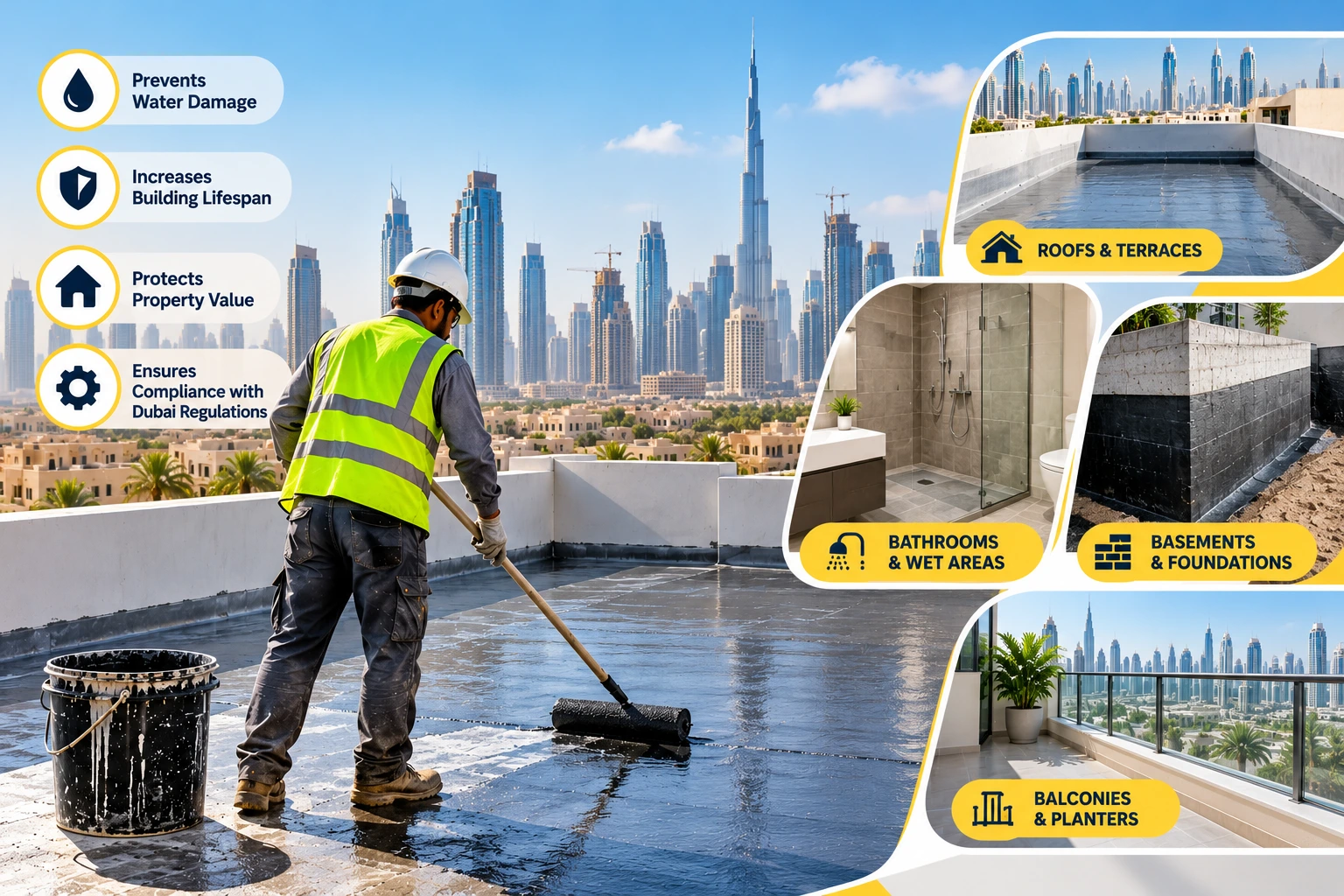
What Areas Usually Require Building Waterproofing in Dubai?
Different areas require different solutions.
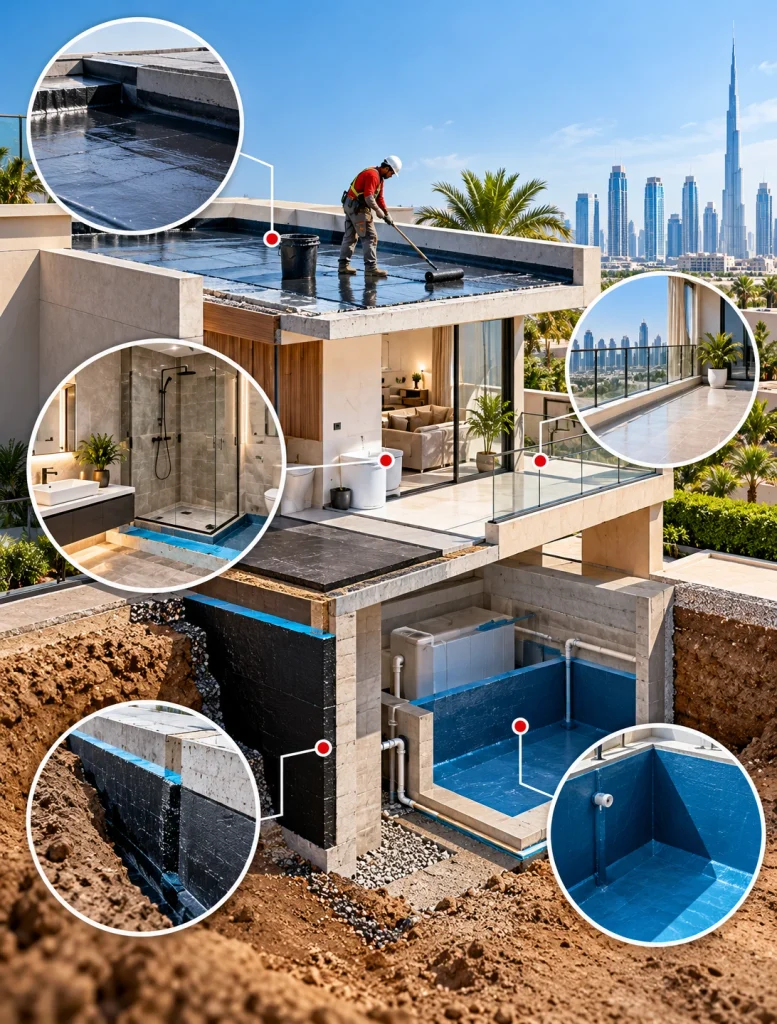
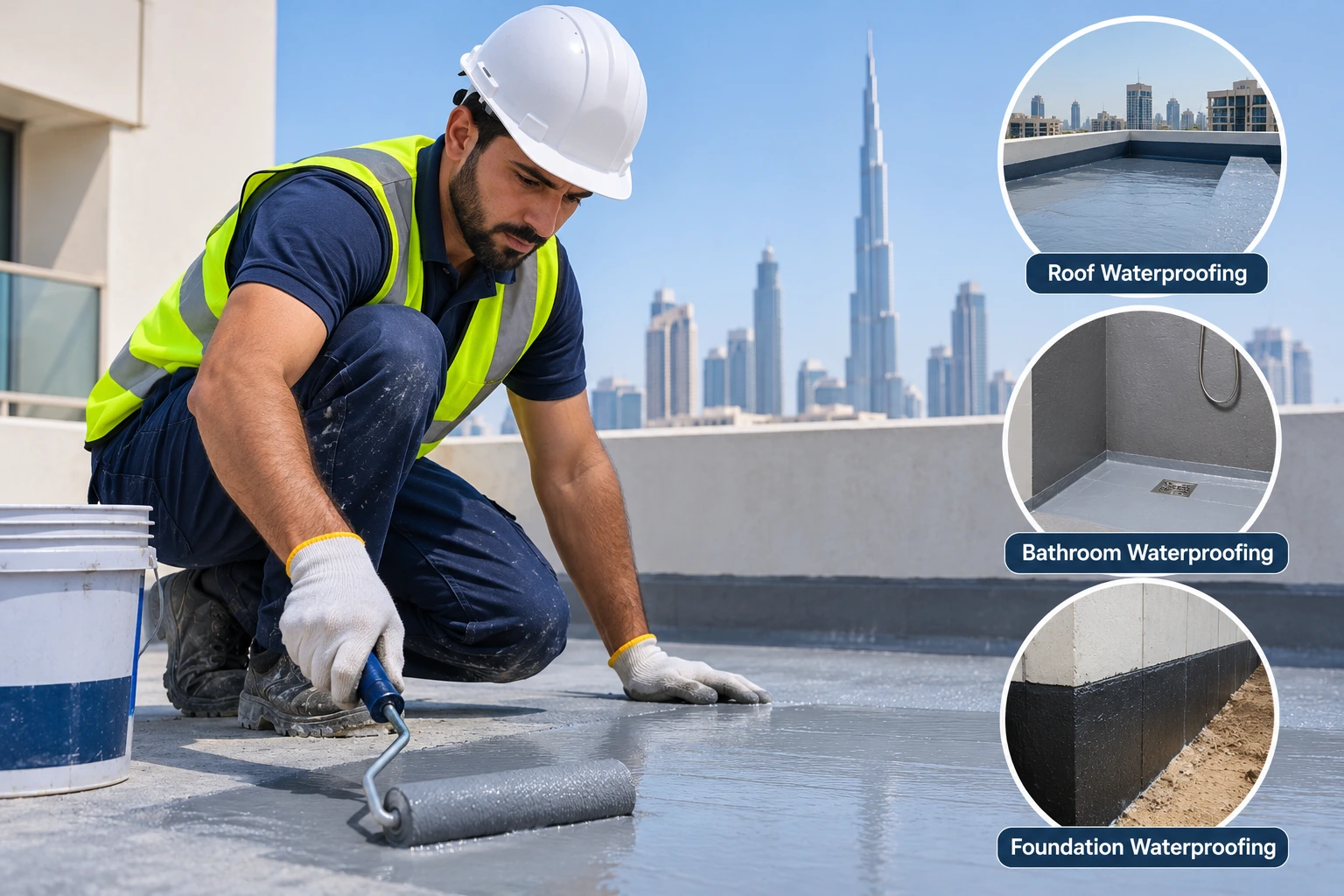
Roofing and Terraces
Roofing can be exposed to weather and direct sunlight. Care must be taken that waterproofing works with your drainage, fall, outlets, upstands, insulation, penetrations and final protection. A perfect membrane installed on a roof where water cannot reach the drain still has an unnecessarily difficult life.
Bathrooms and Wet Areas
Bathrooms require careful detailing around:
- Floor drains
- Wall-to-floor junctions
- Shower areas
- Pipe penetrations
- Niches
- Sanitary connections
Often waterproofing membranes are hidden under screed, adhesive and tiles. It is important that testing takes place before covering your waterproofing.
Basement and Foundations
Waterproofing below ground may be subjected to moisture or pressure from the surrounding ground. The correct approach will depend on site conditions, foundations, access, drainage, groundwater and structural details.
Balconies and Planters
Balconies can be very tricky to waterproof due to the combination of water, movement and drainage. Balconies will also require correct falling to drain. Planters can be tricky to waterproof as they must work with drainage to avoid holding water.
External Walls and Joints
External walls, movement joints, windows, facade penetrations and sealant joints can all allow water into your building. Not all wet ceilings will be directly above the stain. Water is surprisingly good at moving!
Step 1 – Identify the Source of Water and Select Correct Product
If you already have a leak you need to diagnose the issue.
Look for clues such as:
- Damp patches
- Bubbling paint
- Water stains
- Efflorescence
- Cracked grout or sealant
- Failed joints
- Ponding water
- Damaged roof finishes
- Problems around drains
- Moisture beside windows or doors
Ensure you are not assuming the stain is the exact point of water entry. Roofing and terraces can have water move underneath the finishing. Bathrooms may have issues with the plumbing rather than the waterproofing membrane. If the incorrect system is repaired this can be costly and surprisingly un-effective.
Step 2 – Select the Correct Building Waterproofing in Dubai System
There isn’t one best waterproofing product. Professional specifications will determine what waterproofing to use based on substrate, location, exposure, movement, drainage, installation and performance.
Some common types include:
Liquid Applied Membranes
A continuous waterproofing membrane. Often a great option for odd shapes and complex areas as it does not require cutting membranes to shape. Depending on the product there can be polyurethane, acrylic, bitumen, cementitious and other membranes.
Sheet Membranes
Preformed membranes can give controlled thickness. Care must be taken during installation to ensure joints, laps, penetrations, terminations and protection are all correct.
Cementitious Membranes
Depending on the product, cementitious waterproofing can be a good option for certain concrete, masonry, water retention and wet areas.
Bitumen Membranes
Bitumen membranes and coatings are still commonly used on roofing and below ground. Again this depends on the full waterproofing system.
Integral Waterproofing
Integral systems modify the concrete itself through admixtures or other technologies. Dubai Municipality specifically allows qualifying integral waterproofing systems for concrete elements subject to conformity certification and Building Permits Department approval.
Never choose a system simply because somebody says, “We always use this one.” The roof does not care what the contractor normally uses. It cares whether the system suits the roof.
Step 3: Prepare the Substrate Properly
Surface preparation often decides whether waterproofing succeeds.
Before installation, the substrate generally needs to be:
- Structurally sound
- Stable
- Clean
- Free of dust
- Free of loose material
- Free of oil and contaminants
- Properly repaired
- Suitable for the selected membrane
MAPEI for example have guidelines for wet area installations. They require substrates to be structurally sound, dry, solid and stable. Any dust, grease, oil, old coatings and any contaminants that could affect adhesion must be removed. Depending on the product some membranes can be installed onto slightly damp substrates. Some will require a dry substrate. Always refer to the technical data sheet for the product.
Repair Cracks Before Building Waterproofing in Dubai
Cracks, holes, honeycomb and defects may need repairing prior to installation of the membrane. Movement joints are a specialist area to consider. Movement joints are designed to move. Simply painting them with a rigid product won’t stop them moving.
Step 4 – Detail Corners, Drains, Joints and Penetrations
This is where the skill comes in. Many waterproofing systems fail at transitions.
Give particular attention to:
- Internal corners
- External corners
- Floor-to-wall junctions
- Pipes
- Roof outlets
- Balcony drains
- Movement joints
- Door thresholds
- Upstands
- Parapets
- Equipment supports
MAPEI’s waterproofing guidance recommends reinforcing wall-to-wall and wall-to-floor junctions and carefully detailing pipe penetrations and areas where movement may occur.
A beautifully coated 100-square-metre roof can still leak through one badly finished drain. Water has very little respect for percentage completion.
Step 5: Apply the Required Primer in UAE
Many waterproofing systems will require priming. This can help bonding to the substrate, control absorption and prepare for the next layer. However not all systems require the same primer or any primer. Always use an approved system from the manufacturer. Using a random primer can cause compatibility issues. If you don’t use a primer as it costs extra it may cause poor adhesion. Waterproofing is not the best time to experiment with chemistry.
Step 6: Install the Membrane to the Required Specification
Application should follow the approved method statement and manufacturer technical data.
For a liquid-applied membrane, important factors can include:
- Mixing
- Application temperature
- Substrate temperature
- Coat sequence
- Reinforcement
- Consumption rate
- Wet-film or dry-film thickness
- Recoat time
- Curing time
For sheet membranes, installers need to control:
- Alignment
- Overlaps
- Seams
- Corners
- Penetrations
- Terminations
- Adhesion or mechanical fixing
- Damage during following trades
Thickness should never be guessed. Some liquid systems require multiple coats to achieve the intended build-up. Product-specific guidance may also require reinforcement in high-risk areas. A heavy-looking coat is not a measuring instrument.
Step 7: Respect Dubai’s Heat and Site Conditions
Application conditions matter. Manufacturers specify acceptable temperature, humidity, moisture, and curing conditions because waterproofing chemistry changes with the environment. Some products have maximum surface-temperature limits, while others allow much wider ranges. The correct response to Dubai heat is therefore not a universal rule such as “always waterproof before 9 a.m.”
It is to check:
- Product temperature limits
- Substrate temperature
- Direct sunlight
- Wind
- Humidity
- Expected curing conditions
Then organise the work accordingly. A product that begins curing differently because the slab is extremely hot may not behave the way it did in the air-conditioned sample room.
Step 8: Protect the Building Waterproofing in Dubai
The waterproofing membrane can be damaged after successful installation.
This is especially important for:
- Foundations before backfilling
- Roofs before finishes
- Bathrooms before screed or tiling
- Terraces during other trades
- Below-grade walls before drainage-board installation
Sika’s guidance for below-grade liquid waterproofing, for example, calls for suitable protection or drainage layers after curing where backfilling or hydrostatic conditions apply. Do not allow following trades to treat completed waterproofing as a convenient workbench. One dropped sharp tool can turn a very expensive membrane into a surprisingly small hole.
Step 9: Test Before Covering the System
By testing you can save a lot of work. If the project and waterproofing require it, horizontal waterproofing areas may require a watertight/flood test before covering with finishes. For example one of the current waterproofing specifications from Sika GCC for a bitumen membrane suggests podium, wet areas and roof structures should be tested for watertightness as per project requirements. However only 48hrs of flooding at 50mm depth is required.
Another Sika Waterproofing guide for a liquid system suggests 24-48hrs of flooding. These aren’t rules for all membranes. Always follow the project specification and manufacturers requirements. The main rule to remember is; If the system requires testing then test before covering. It is frustrating to find a leak prior to tiling. It is much more educational to find it after marble, cabinetry, ceilings and furniture have been installed!
Step 10: Complete Finishes Without Damaging the Membrane
After successful inspection and testing, complete the protection layer, screed, tile system, insulation, drainage layer, backfill, or other specified finish. Make sure adhesives and finishing materials remain compatible with the waterproofing system.
Also preserve drainage falls. Waterproofing should prevent water penetration, but good design should also move water away. A membrane is protection. It should not be asked to operate a permanent swimming pool on the roof.
Common Waterproofing Mistakes
Several errors appear repeatedly across waterproofing projects:
- Poor surface preparation
- Using the wrong system
- Ignoring cracks
- Incorrect membrane thickness
- Weak detailing around drains
- Skipping required primer
- Covering before full cure
- Mixing incompatible products
- Damaging completed waterproofing
- Ignoring drainage
- Failing to test the system
- Treating every leak with waterproof paint
Waterproof paint can have valid applications. It is not a universal cure for leaking roofs, failed bathroom membranes, foundation water pressure, or defective plumbing. Diagnosis comes first.
How Do You Maintain Building Waterproofing in Dubai?
Waterproofing should form part of property maintenance.
Inspect exposed areas periodically and look for:
- Failed sealant
- Blocked drainage
- Ponding water
- Cracked finishes
- Damaged joints
- Loose tiles
- Blistering coatings
- New damp patches
Keep roof drains, balcony outlets, and terrace drainage paths clear. If you notice a leak, investigate early. Water damage rarely improves through patience.
How to Choose a Waterproofing Contractor in Dubai
Ask potential contractors:
- Which waterproofing system do you recommend and why?
- What substrate preparation will you carry out?
- Which exact product system will you use?
- Is the material appropriately certified or approved where required?
- How will you treat joints and penetrations?
- What application thickness does the manufacturer require?
- How will the completed membrane be tested?
- How will it be protected afterwards?
- What warranty applies?
- Can you show similar completed work?
Dubai Central Laboratory provides product-certification and technical-approval services for building materials, and Dubai Municipality maintains lists of certified products. For regulated systems, ask for documentation rather than accepting “good quality material” as a complete specification.
Building Waterproofing in Dubai With Perfect General Contracting LLC
Perfect General Contracting LLC includes waterproofing within its civil, exterior maintenance, renovation, and property-maintenance services in Dubai and the wider UAE. Its published services cover waterproofing for areas including roofs, bathrooms, terraces, and external surfaces alongside related concrete, masonry, flooring, plumbing, and repair work.
That broader multi-trade capability can be useful because a waterproofing problem may also require drainage correction, concrete repair, tiling, plumbing, plaster repair, or exterior finishing.
The important first step remains the same: identify the cause, define the correct system, and repair the complete problem rather than only hiding the visible stain.
FAQs
What is the best Building Waterproofing in Dubai method?
There is no single best method. The right system depends on whether you are waterproofing a roof, bathroom, basement, terrace, foundation, planter, or another area, along with the substrate, movement, drainage, and exposure conditions.
How many coats of waterproofing should be applied?
It depends entirely on the selected product system. Some liquid membranes require multiple coats, while sheet membranes follow a completely different installation method. Use the manufacturer’s specified consumption and thickness.
Can Building Waterproofing in Dubai be applied over a damp surface?
Some products permit damp substrates and others do not. Check the technical data sheet for the specific membrane.
Should Building Waterproofing in Dubai be tested before tiling?
Where the approved system and project specification require a water-tightness test, complete it after the membrane has cured and before covering the waterproofing.
Is waterproofing paint enough for a leaking roof?
Not automatically. A roof leak may result from failed membranes, joints, penetrations, drains, cracks, flashing, or other defects. Diagnose the source before selecting the repair.
Can Building Waterproofing in Dubai solve a plumbing leak?
No. If a pipe, drain, fitting, or water connection leaks, repair the plumbing problem first.
Final Thoughts
Successful building waterproofing in Dubai depends less on finding a miracle product and more on following the correct process. Identify the source of water. Understand the exposure. Choose a suitable system. Prepare the substrate. Repair defects. Detail corners, joints, drains, and penetrations carefully. Apply the membrane according to its technical requirements. Protect it. Test it before covering where required.
And maintain the building afterwards. Dubai Municipality’s waterproofing requirements also reinforce the importance of approved and properly certified systems rather than informal product selection. Good waterproofing is almost invisible once construction finishes. That is exactly how you want it. If the waterproofing becomes the most noticeable feature of your property, something has probably gone very wrong.