Hiring a general contractor in Dubai can determine whether your construction or renovation project feels organised or becomes a second full-time job you never applied for. A good contractor does more than send workers to the site.
They coordinate trades, materials, subcontractors, schedules, inspections, quality control, safety, changes, and final handover. On larger projects, the general contractor becomes the central point connecting drawings, consultants, suppliers, specialist contractors, and the client. That makes choosing the right company one of the most important decisions you will make before construction starts.
If you are wondering how to hire a general contractor, do not begin by comparing prices alone. Start by checking whether the contractor can legally, technically, and commercially deliver your actual project. For projects in Dubai, that also means verifying appropriate licensing, contractor registration, permit knowledge, and compliance with local construction requirements.
Here is a practical step-by-step guide.
What Does a General Contractor Actually Do?
A general contractor manages the execution of a construction project across multiple trades.
Depending on the agreed scope, the contractor may coordinate:
- Site preparation
- Structural works
- Blockwork
- Waterproofing
- Electrical systems
- Plumbing
- HVAC
- Aluminium and glass
- Flooring
- Ceilings
- Painting
- Carpentry and joinery
- Landscaping
- Specialist subcontractors
- Testing and snagging
- Final handover
The company may complete some work using its own staff and subcontract specialist packages. That is normal. The important question is not whether subcontractors exist. It is who coordinates them and takes responsibility for the contracted work.
If the plumber, electrician, ceiling installer, and AC contractor all need the same section of ceiling, someone must manage the sequence. Otherwise, the ceiling becomes a meeting room.
1. Define Your Project Before Contacting General Contractor in Dubai
Before requesting quotations, decide what you actually want built.
Your initial scope should identify:
- Project type
- Property location
- Approximate size
- New construction or renovation
- Main work required
- Expected finishing level
- Known design requirements
- Desired start period
- Relevant drawings or specifications
You do not need every door handle selected before approaching contractors. You do need enough information for different companies to price approximately the same project.
If every contractor receives different information, comparing their quotations becomes almost meaningless. A detailed brief improves the quality of the quotation and reduces misunderstandings later.
2. Verify the Contractor’s Licence and Registration
Never skip this step. For Dubai projects, Dubai Municipality places contracting companies within a formal regulatory framework covering licensing, contracting activities, technical-staff requirements, professional registration, and company evaluation.
Ask the contractor for:
- Legal company name
- Trade licence
- Relevant contracting activity
- Dubai Municipality registration
- Contractor classification where applicable
- Details of technical personnel
You can also check contractor information using Dubai Municipality’s official contractor resources. Do not assume that every company using words such as contracting, construction, or engineering can legally perform every type of work.
Contracting activities differ. The right contractor should have an activity that matches your project.
3. Look for Relevant Project Experience in UAE
Years of experience matter, but relevant experience matters more. A contractor that has successfully built warehouses may be highly competent without necessarily being your first choice for a luxury villa renovation.
Ask for projects similar to yours in:
- Size
- Building type
- Technical complexity
- Finishing standard
- Location
- Construction method
If you are renovating a villa, ask to see villa renovations. If you are building a commercial property, ask for commercial projects. Look beyond polished final photographs.
Ask what the contractor actually delivered and whether the same team worked on those projects. A portfolio should provide evidence, not just decoration for the sales presentation.
4. Meet the People Who Will Run Your Project in UAE
You may initially meet a salesperson, estimator, or company director. The project itself will usually depend on a different group of people.
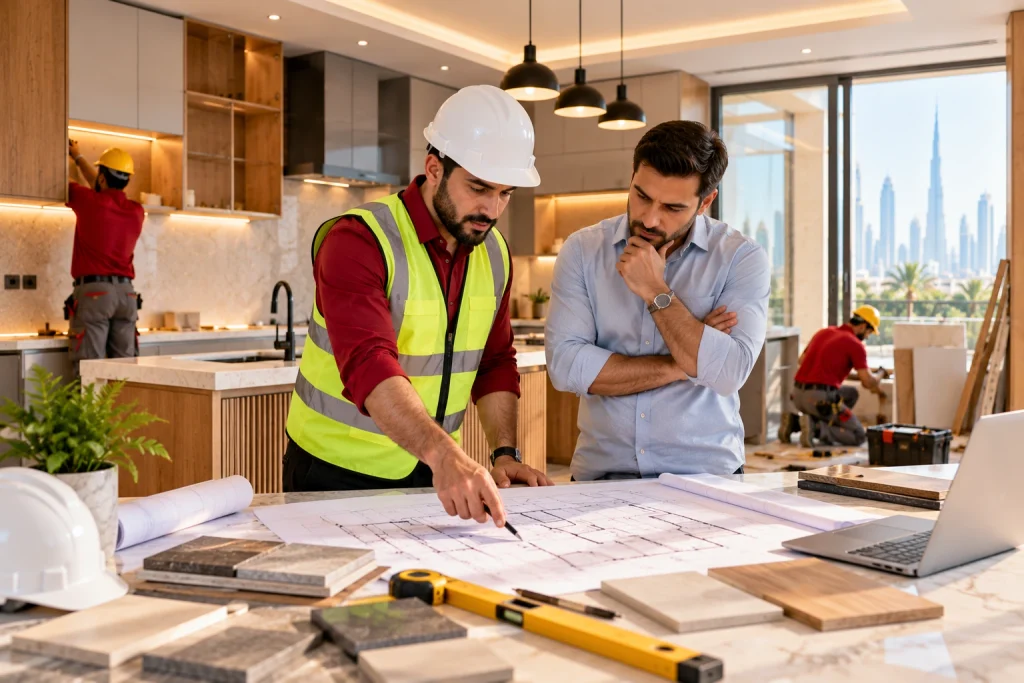
Ask who will become your:
- Project manager
- Site engineer
- Site supervisor
- Quantity surveyor
- Safety contact
- Main communication contact
For larger projects, ask about MEP coordination and quality-control personnel as well. Find out how often the project manager will visit the site and whether that person manages several other projects simultaneously.
A strong company with the wrong team allocation can still create difficulties. You are hiring an organisation, but you will experience the project through the people assigned to it.
5. Ask About Permits and Authority Procedures in UAE
A contractor should understand the approval process that applies to your project. Dubai Municipality’s Building Control and Building Permits Department maintains procedures for building permits, construction-site inspections, and completion certificates for projects including residential villas, industrial buildings, and multi-storey buildings.
Before signing, clarify:
- Which permits are required?
- Who applies for them?
- What does the consultant handle?
- What does the contractor handle?
- Who requests inspections?
- Who manages completion procedures?
Do not leave this as “we will sort it out later.” Later is an expensive time to discover that everybody thought somebody else was responsible.
6. Request a Detailed Written Quotation from General Contractor in Dubai
A quotation should tell you much more than the final price.
Look for a breakdown covering relevant items such as:
- Preliminaries
- Demolition
- Structural work
- Waterproofing
- MEP
- Flooring
- Ceilings
- Painting
- Doors
- Aluminium and glazing
- Joinery
- External work
- Waste removal
- Testing
- Handover
Then inspect the exclusions. Exclusions matter almost as much as inclusions. For example, one contractor may include waste removal, temporary protection, testing, and final cleaning while another excludes all four. The second quotation may appear cheaper simply because it contains less.
7. Compare Specifications, Not Just Totals in UAE
Never compare two contractor prices until you confirm that both companies priced the same materials and systems.
Check specifications for:
- Waterproofing
- Insulation
- Tiles
- Sanitaryware
- Electrical accessories
- Aluminium systems
- Glass
- Paint
- Doors
- Hardware
- Joinery
- HVAC equipment
Pay attention to allowances and provisional sums. A small allowance can make the original contract price look attractive while leaving you with substantial upgrades later. The cheapest quotation is useful only if it delivers the same scope. Otherwise, you are not comparing prices. You are comparing different projects.
8. Understand the Payment Schedule With General Contractor in Dubai
Do not pay based on vague statements such as “30% when the project is halfway finished.” Your contract should connect payments to clearly defined stages or other agreed commercial terms.
Ask for a schedule showing:
- Initial payment
- Progress payments
- Material payments where applicable
- Milestones
- Retention if agreed
- Final payment
- Variation payments
For UAE budgeting, remember tax treatment as well. The Federal Tax Authority states that construction services supplied in the UAE are generally subject to 5% VAT.
Confirm whether VAT appears inside or outside the quoted total. A five-percent surprise feels much larger when attached to a construction contract.
9. Put the Contract in Writing
A detailed contract protects both sides. Dubai Municipality has prepared guidance contract forms for private-villa construction specifically to clarify responsibilities and help reduce contractual, financial, and legal disputes. The Municipality states that these templates are guidance rather than mandatory contracts and parties may amend them by agreement.
Your contract should address matters such as:
- Scope
- Contract price
- Payment terms
- Programme
- Responsibilities
- Variations
- Delays
- Approvals
- Materials
- Subcontractors
- Defects
- Warranties
- Handover
- Dispute procedures
For significant projects, consider having the contract reviewed by an appropriate legal professional before signing. A handshake shows goodwill. A clear contract remembers details better.
10. Agree on a Variation Process in UAE
Changes happen during construction. The client may change a finish. The designer may revise a detail. Site conditions may reveal an unexpected problem. The contract should explain how changes receive approval.
A sensible variation process identifies:
- What changes
- Why it changes
- Additional or reduced cost
- Programme impact
- Who approves it
Avoid approving substantial additional work verbally. A casual “yes, go ahead” can develop an impressive memory by invoice day. Require written pricing before significant changes proceed whenever practical.
11. Review the Project Programme in UAE
Ask how the General Contractor in Dubai plans to complete the work, not simply when.
A construction programme might include:
- Mobilisation
- Demolition or excavation
- Structural stages
- Blockwork
- MEP first fix
- Waterproofing
- Plastering
- Finishes
- Joinery
- Equipment installation
- Testing
- Snagging
- Handover
Ask which materials have long lead times. Ask which stages depend on inspections or approvals. A realistic programme is more valuable than an aggressive date designed to win the contract. Construction does not become faster because somebody used bold font for the completion date.
12. Evaluate Construction Safety in UAE
A professional General Contractor in Dubai should take site safety seriously. Dubai’s Decree No. 19 of 2025 requires contractors and engineering consultancy firms carrying out construction works to comply with Dubai’s applicable construction-safety rules. In June 2026, Administrative Resolution No. 112 formally approved the Safety Guide for Construction Works in the emirate. When possible, visit an active site operated by the contractor.
Look at:
- PPE
- Scaffolding
- Site access
- Temporary electrical systems
- Material storage
- Working-at-height practices
- Housekeeping
- Barricades
- General site organisation
You do not need to perform a formal safety audit. You can still learn a lot from whether a site looks controlled or chaotic.
13. Ask How Quality Gets Checked in UAE
Do not wait until handover for the contractor to discover its own defects. Ask about quality-control procedures during construction.
Important checks may occur before:
- Concrete placement
- Waterproofing gets covered
- Ceilings close
- Walls receive final finishes
- Tiles become permanently fixed
- Joinery receives final approval
Testing can also apply to plumbing, electrical systems, waterproofing, HVAC, and other services. Dubai Municipality’s building-permit process includes technical inspections of sites under construction as part of the regulatory process. Authority or consultant inspections do not replace the contractor’s own quality management. A good contractor should find mistakes before everyone else does.
14. Check References and Visit Previous Projects in UAE
Ask for recent client references. Then actually contact them.
Useful questions include:
- Was communication clear?
- Were costs explained properly?
- How did the contractor handle variations?
- Did the project team remain responsive?
- Were defects corrected?
- How did the company behave after payment?
- Would you hire them again?
If possible, visit a completed project. A completed building tells you things a website photograph cannot. Look at joints, finishes, doors, ceilings, tiles, cabinetry, paint, glazing, and overall workmanship. Do not expect absolute perfection. Look for consistency and attention to detail.
15. Review Warranty and Handover Requirements in UAE
Before hiring the General Contractor in Dubai, understand what happens at the end.
A proper handover may include:
- Snagging
- Defect correction
- Test records
- Manufacturer warranties
- Equipment manuals
- As-built information where applicable
- Completion documents
- Keys and access devices
- After-sales contact information
Make sure warranty promises appear in writing. “Call us anytime” sounds reassuring until the person who said it changes jobs. Written obligations age better than conversations.
Red Flags When Hiring a General Contractor in Dubai
Be cautious when a contractor:
- Refuses to provide licence details
- Gives a very vague quotation
- Cannot show similar projects
- Pressures you to sign immediately
- Requests unusual payments without explanation
- Avoids written variation procedures
- Cannot identify the site team
- Makes unrealistic schedule promises
- Shows poor safety practices
- Provides unclear warranty terms
One issue may have a reasonable explanation. Several together usually tell you something useful.
Questions to Ask Before Hiring a General Contractor in UAE
Before making the final decision, ask:
- Are you licensed and registered for this work?
- Have you completed similar projects?
- Who will manage my site?
- Which work will you subcontract?
- What does your quotation exclude?
- What material specifications have you priced?
- Who handles permits and inspections?
- How do you manage variations?
- What is the construction programme?
- How do you control quality?
- What warranties do you provide?
- Can I speak with previous clients?
A competent contractor should answer these questions clearly. You are not being difficult. You are considering giving someone responsibility for a building and a significant amount of money. Questions seem appropriate.
Final Thoughts
Learning how to hire a general contractor comes down to checking evidence before trusting promises. Verify the licence. Review similar projects. Meet the team. Understand the quotation. Compare specifications. Check permits, safety, payments, variations, quality-control procedures, references, warranties, and handover responsibilities.
For Dubai projects, contractor licensing, building permits, site inspections, construction safety, and completion procedures all operate within formal regulatory frameworks. The goal is not to find the contractor who promises that nothing will ever go wrong. Construction is too complicated for that promise to mean much. Find the contractor who can explain what it will do when something does. That is usually where professionalism becomes easiest to recognise.